
A product roadmap should do more than list features.
At its best, a roadmap helps everyone understand three things: where the product is going, why those priorities matter, and what the team should focus on next.
In practice, though, many roadmaps become long wish lists. They collect feature requests from customers, ideas from leadership, technical improvements from engineering, and internal requests from different teams. Eventually, everything looks important.
That is where the roadmap stops being useful.
A good roadmap is not about showing how much you plan to build. It is about showing what matters most and why.
Why Product Roadmaps Often Fail
One of the most common problems I see is that roadmaps are built around outputs instead of outcomes.
For example:
Feature-focused roadmap item:
Build a new analytics dashboard.
That tells the team what to build, but it does not explain why it matters.
A stronger roadmap item would be:
Outcome-focused roadmap item:
Reduce the time customers need to understand business performance by 50%.
Now the team has a problem to solve, not just a feature to deliver.
A redesigned dashboard might be the answer. But perhaps better alerts, improved reporting, or a simpler workflow would solve the problem more effectively.
That distinction is important.
When a roadmap becomes a list of predetermined solutions, teams lose room to think.
Other common problems include roadmaps that are too rigid, disconnected from business goals, driven by the loudest stakeholder, or created without enough customer feedback.
The result is usually the same: the team ships a lot, but it becomes difficult to explain what actually improved.
Start With the Outcome
Before adding anything to a roadmap, I like to ask a simple question:
What should be different after we complete this work?
The answer should normally connect to a measurable product or business result.
It might be:
Increase activation for new customers
Reduce onboarding time
Improve checkout conversion
Reduce support requests
Improve retention
Increase feature adoption
Reduce operational work for internal teams
This changes the roadmap conversation significantly.
Instead of asking:
“Which features should we build next?”
you start asking:
“Which problems are preventing us from reaching the outcome we want?”
That is a much better product conversation.
Use Now, Next, Later Instead of Pretending We Know the Future
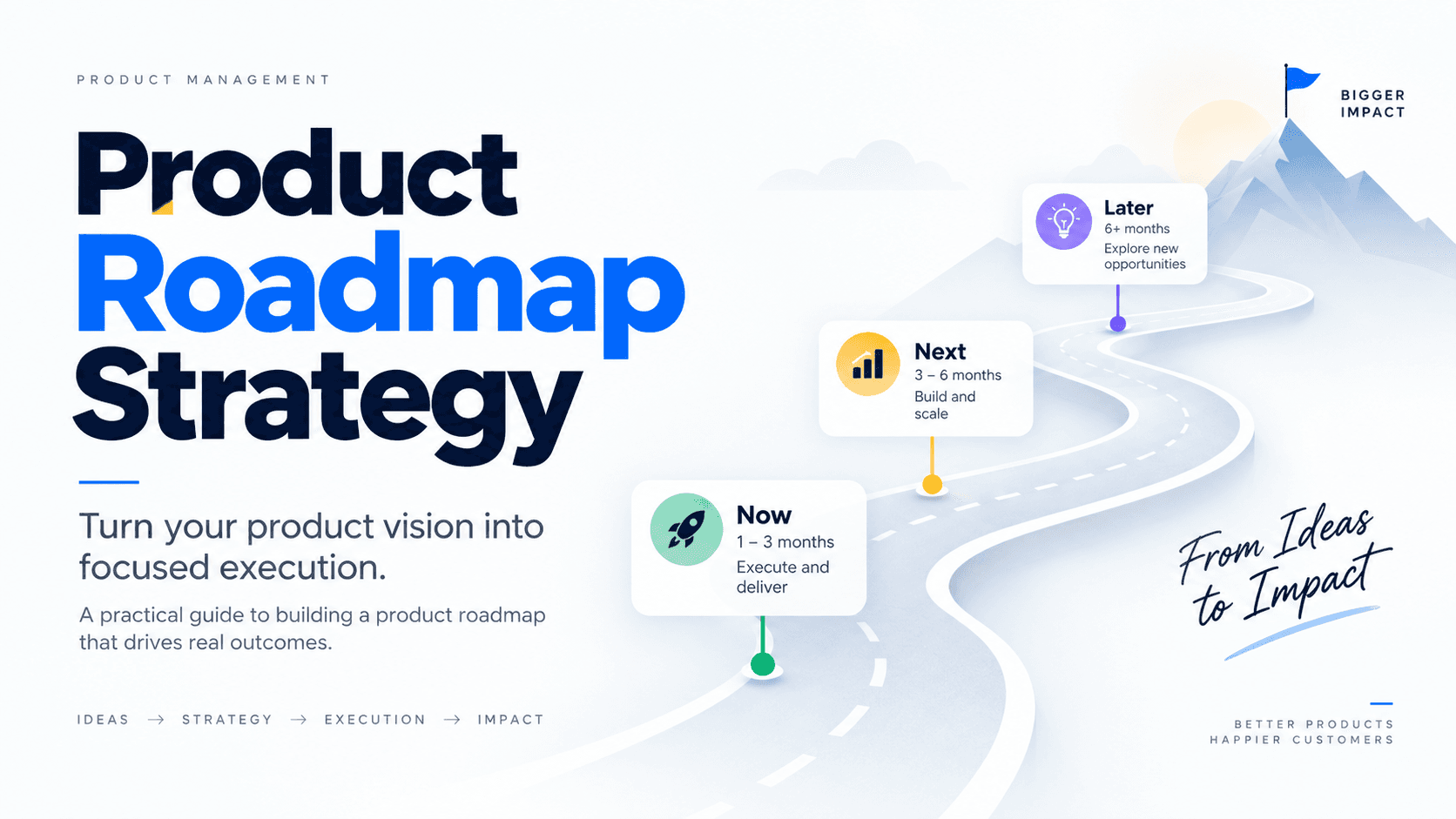
I prefer the Now–Next–Later framework for most product roadmaps because it reflects how product development actually works.
Now
These are the priorities the team is actively working on or preparing to work on.
Usually, this covers roughly the next one to three months.
The scope should be relatively clear because the team has already done enough discovery to understand the problem and likely solution.
Next
These are important problems or opportunities that are likely to follow.
The direction should be clear, but the implementation may still change as we learn more.
This might cover the next three to six months.
Later
These are future opportunities worth keeping visible, but they should not be treated as commitments.
The further we look into the future, the less certainty we have.
That is normal.
Trying to create a feature-by-feature roadmap for the next 12 or 18 months often creates false certainty. Customer needs change. Competitors change. Business priorities change. Technical realities change.
A roadmap should provide direction without pretending the future is completely predictable.
Prioritization Is Where Product Strategy Becomes Real
The difficult part of roadmap planning is rarely generating ideas.
There are always more ideas than engineering capacity.
The difficult part is deciding what not to build.
One framework I use when useful is RICE:
Reach — How many users or customers will this affect?
Impact — If successful, how much difference will it make?
Confidence — How confident are we in our assumptions and supporting evidence?
Effort — How much time and engineering effort will it require?
The basic principle is simple: prioritize initiatives that can create meaningful impact relative to the effort required.
But I would not rely on RICE scores blindly.
A spreadsheet should not make the product decision for you.
Some initiatives may have strategic importance that is difficult to represent with a score. Security, compliance, infrastructure, technical debt, or an important enterprise requirement may deserve priority even if their RICE score is not particularly impressive.
Frameworks help structure the discussion. They should not replace judgment.
A Roadmap Should Connect Product and Business Strategy
Every major roadmap item should have a clear connection to the broader goals of the business.
If the company wants to improve retention, the roadmap should show initiatives connected to retention.
If the priority is expansion into a new market, localization, payments, integrations, or onboarding may become more important.
If the goal is operational efficiency, automation and workflow improvements may deserve more attention than new customer-facing features.
This alignment matters because it gives the team context.
Engineers should understand why a project matters.
Designers should understand what behavior they are trying to influence.
Stakeholders should understand why one request was prioritized while another was delayed.
When everyone understands the reason behind the roadmap, execution becomes much easier.
Customer Feedback Should Influence the Roadmap, Not Control It
Customer feedback is critical, but there is an important distinction between listening to customers and building everything customers request.
Customers are usually very good at explaining their problems.
They are not always responsible for designing the best solution.
If several customers ask for a particular feature, I try to understand the problem behind the request.
Why do they want it?
What are they trying to accomplish?
How are they solving the problem today?
What happens if the problem is not solved?
Sometimes ten different feature requests are actually ten versions of the same underlying problem.
That is where product discovery becomes valuable.
Instead of building ten features, you may discover one better solution.
Keep the Roadmap Flexible
A roadmap should be a strategic communication tool, not a contract.
This is particularly important for the “Next” and “Later” sections.
If research shows that an assumption was wrong, the roadmap should change.
If customers respond differently than expected, priorities should change.
If a new market opportunity becomes important, priorities may change.
Changing a roadmap based on new evidence is not poor planning.
Continuing with an outdated plan simply because it was written six months ago is far worse.
The roadmap should remain stable enough to provide direction, but flexible enough to respond to reality.
Communication Matters as Much as Planning
A roadmap has little value if only the product team understands it.
Different audiences need different levels of detail.
With the delivery team, roadmap conversations should happen frequently. Engineers and designers need context around priorities, dependencies, and changes.
With internal stakeholders, a monthly roadmap review is usually useful. It keeps expectations aligned and creates a place to discuss changing priorities.
With customers, I prefer broader directional communication rather than promising exact delivery dates too early.
The conversation should focus on problems being solved and areas of investment rather than turning every roadmap item into a contractual commitment.
The important thing is consistency.
Stakeholders become frustrated when priorities appear to change without explanation. If the reasoning is communicated clearly, most people are much more comfortable with change.
Measure Whether the Roadmap Is Working
Shipping an item from the roadmap does not automatically mean it was successful.
After release, I want to know what changed.
Did customers actually use the feature?
Did the workflow become faster?
Did conversion improve?
Did support tickets decrease?
Did retention improve?
Did the initiative produce the business outcome we expected?
This creates an important feedback loop:
Problem → Hypothesis → Build → Measure → Learn → Adjust
Without the measurement step, teams can become very efficient at shipping things without knowing whether those things matter.
What Changed When We Used This Approach
Using a more outcome-driven roadmap approach helped create much stronger alignment between product, engineering, and stakeholders.
Among the results we saw were:
80% feature adoption
25% faster time to market
90% stakeholder satisfaction
Better visibility into priorities across teams
But the most valuable improvement was not any single metric.
It was clarity.
The team understood what we were trying to achieve. Stakeholders understood why certain initiatives were prioritized. And roadmap discussions became less about individual feature requests and more about customer and business outcomes.
Final Thoughts
A strong product roadmap is not a list of promises.
It is a tool for making decisions.
It connects product vision with execution while leaving enough flexibility for the team to learn along the way.
For me, the most useful roadmap principles are simple:
Start with outcomes, not features.
Prioritize based on impact, evidence, and effort.
Keep the near term clear and the long term flexible.
Explain the reasoning behind priorities.
Measure what happens after you ship.
And perhaps most importantly:
A roadmap should help the team decide what not to build.
That is often where real product strategy begins.