
A few years ago, whenever I had a product idea, I had to explain it to developers, prepare documents, review designs, wait for development, test the result, and then explain the changes again.
The process worked, but it was slow.
Then I started using AI for software development.
At first, I used ChatGPT to generate small pieces of code and copied them into my projects. Later, I began using tools such as Claude Code, Amazon Q, Codex, and other AI coding agents directly inside my development environment.
That was when I realised there is a major difference between simply generating code and using an AI agent to complete a development task.
Today, agentic coding is changing how I work as a Product Manager.
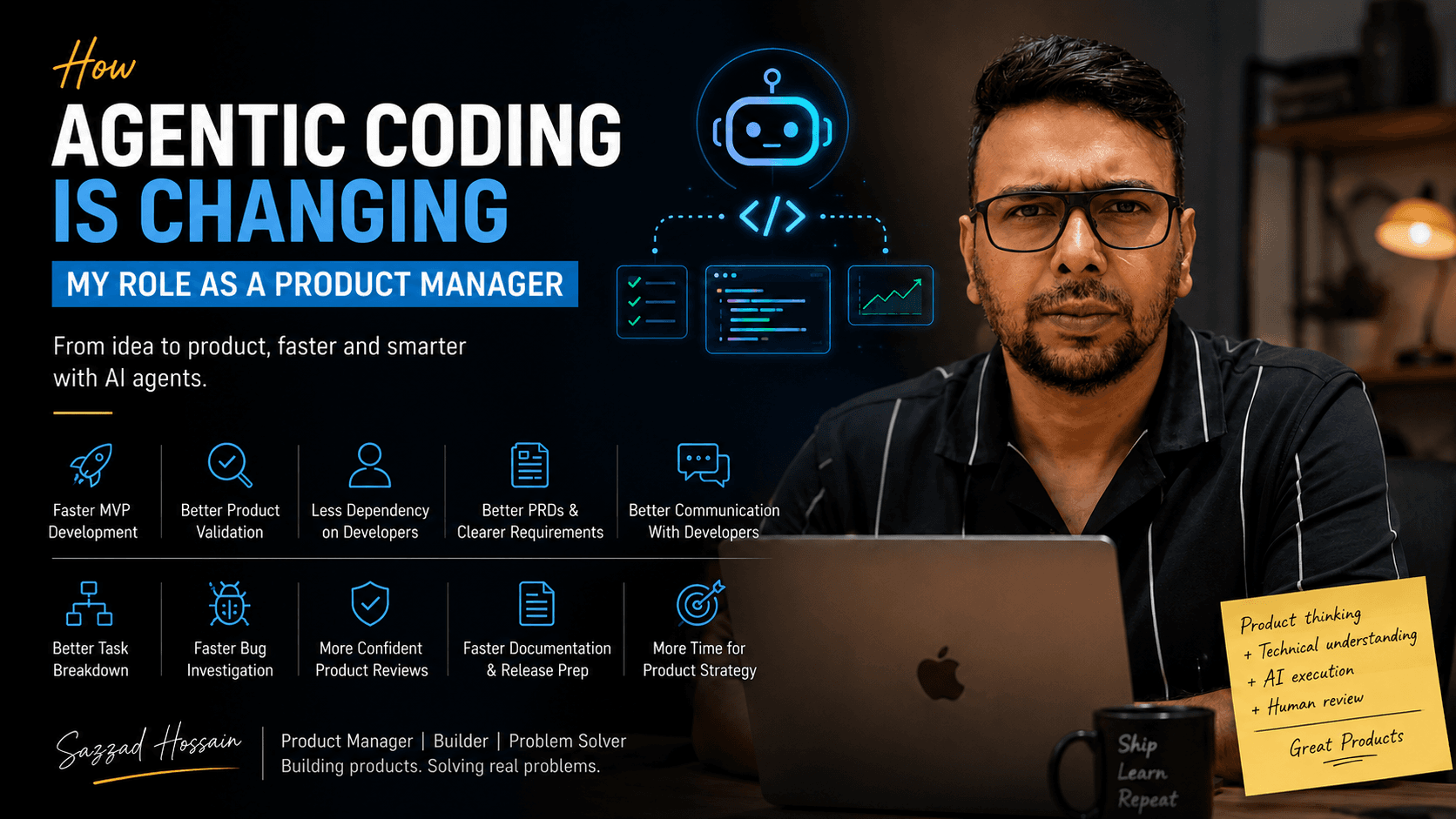
Here are the top 10 benefits I have experienced.
1. Faster MVP Development
I can now turn an idea into a basic working product much faster.
Instead of only preparing documents and wireframes, I can build a functional prototype and test whether the concept actually works.
2. Better Product Validation
A feature may sound excellent during a discussion but feel completely different when someone uses it.
Agentic coding allows me to build an early version, collect feedback, and validate the idea before investing too much development time.
3. Less Dependency on Developer Availability
Development teams are often busy with production issues, customer requests, and roadmap commitments.
I can now build small prototypes, internal tools, and product experiments without interrupting the core development team.
4. Better PRDs
When I ask an AI agent to implement a feature, it immediately exposes missing requirements.
It forces me to think about permissions, validation, error handling, empty states, edge cases, and business rules.
This helps me create clearer and more implementation-ready PRDs.
5. Better Communication With Developers
A working example can explain an idea better than several pages of documentation.
I can show developers the expected workflow, user experience, validation, and business behaviour instead of relying only on written explanations.
6. Better Task Breakdown
Agentic coding helps me understand which frontend, backend, database, API, and testing tasks are involved in a feature.
This allows me to create smaller tasks, improve estimation, and reduce uncertainty during sprint planning.
7. Faster Bug Investigation
Instead of reporting that “the system is slow” or “the stock is incorrect,” I can analyse logs, review workflows, inspect queries, and provide developers with more useful information.
This makes bug resolution faster and more structured.
8. More Confident Product Reviews
I can understand which files changed, what business logic was added, whether the database was modified, and what risks should be reviewed.
This helps me participate more confidently in UAT, release planning, and technical discussions.
9. Faster Documentation
AI agents can help prepare release notes, implementation summaries, test cases, API documentation, and user guides based on actual product changes.
This saves time and keeps documentation closer to the real system.
10. More Time for Product Strategy
The biggest benefit is not coding faster.
It is reducing the time I spend on repetitive work so I can focus more on customers, product strategy, prioritisation, growth, and business decisions.
But Not Every Product Manager Can Do This
This is an important reality.
Not every Product Manager can use vibe coding or agentic coding to build and launch a product.
AI can generate code, but it cannot replace technical judgement.
A working screen does not automatically mean the product is production-ready. A real product also requires proper architecture, database design, authentication, security, testing, monitoring, backup, performance, deployment, and rollback planning.
A Product Manager does not necessarily need to be a professional software developer. However, anyone who wants to independently build and launch a product using AI needs a strong technical foundation.
They should understand how the frontend, backend, database, APIs, cloud infrastructure, security, testing, and deployment process work together.
Without this knowledge, AI coding should mainly be used for prototypes and product validation—not uncontrolled production development.
My Final Thought
Agentic coding will not replace developers.
It will make technically capable Product Managers more effective.
For me, the real advantage is the ability to move faster between product thinking and technical execution.
The future Product Manager will not only write requirements and manage roadmaps. They will also know how to guide AI agents, review their work, understand technical risks, and turn ideas into working products.
The strongest combination will be:
Product judgement + technical knowledge + AI execution + human review.