
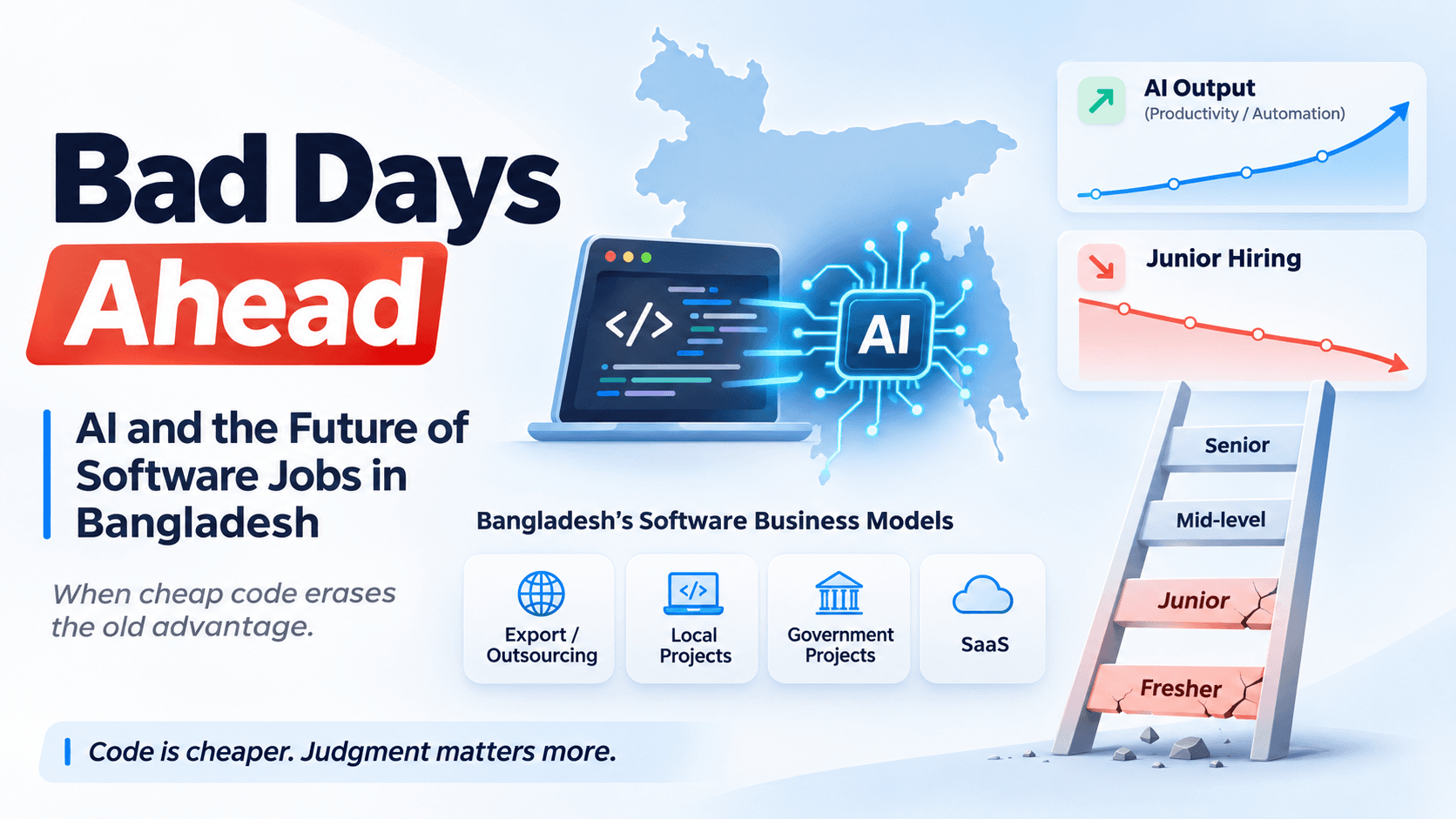
Bangladesh's software industry was built on one advantage: developers are cheap. AI is now making code itself cheap, and that erases the advantage faster than any rival country ever could.
The first people to pay are not senior architects. They are fresh graduates and junior developers, whose job was to write exactly the kind of code AI now writes in seconds.
The signs are already here. BASIS says its roughly 2,800 member companies employ at least 300,000 software engineers, and some firms report fresher hiring has fallen by half or more in the past year (News Karnataka, Sep 2026). One Dhaka company owner put it bluntly to The Daily Star: he has not hired a fresher in over a year, because one senior using Claude does the work of two or three juniors (Daily Star, Jun 2026).
This article walks through how local software companies make money today, why each model was already fragile, what AI does to each one, and who gets hurt first.
How Bangladeshi software companies make money today
Almost every local software company earns from some mix of four models. All four, in the end, sell developer hours, directly or hidden inside a product.
Export / outsourcing. Foreign clients pay (the US takes about 34% of exports, the UK about 13%). Teams or projects are billed per hour or per head. Weakness: it wins only on price, for low- to mid-complexity work.
Local custom projects. Banks, corporates, NGOs and conglomerates pay a fixed price for a build, plus annual maintenance. Weakness: price wars, scope creep and late payment.
Government projects. Ministries and public bodies award large tendered projects. Weakness: very few firms win, and winning needs a big portfolio and connections.
SaaS / products. SMEs, retailers and schools pay a monthly or yearly subscription. Weakness: acquiring and onboarding each customer costs a lot.
The industry is bigger than its export figures. Bangladesh hosts more than 4,500 software and IT service companies, and the ICT market reached an estimated $8.88 billion in 2025 (TBS). But most of that value is still labour: people writing, testing and maintaining code for someone else.
That is the core point. Whether a company bills hourly abroad or fixed-price at home, its margin comes from the gap between what it pays a developer and what it charges for that developer's output. AI attacks that exact gap.
Why the local market was already broken
Long before AI, running a software company on the domestic market was a hard business. Three problems keep repeating.
1. Software is priced like a commodity. Thousands of firms and a huge freelance pool compete for the same corporate buyers. Entry-level developers earn roughly BDT 15,000–35,000 a month (Daily Star), so a buyer can always find someone cheaper. Clients ask for heavy customisation, vendors say yes to everything to win the deal, and the project turns fragile later (Daily Star).
2. Corporate clients pay late. A local project often has three payment milestones on paper and six months of chasing in practice. The vendor has already paid salaries for that work. When clients slow down, the damage is fast: during the 2020 shock, local-market firms lost about half their work orders and could not collect money already owed (TBS). The same thing happens on a smaller scale every year, and it quietly kills small firms that live month to month.
3. SaaS is cheap to sell but expensive to land. In theory SaaS fixes both problems: recurring revenue, no custom builds. In practice a Bangladeshi shop owner rarely signs up from an online ad and onboards alone. He needs a salesperson to visit, someone to install and configure, and physical training for staff, often more than once. A subscription of a few thousand taka a month can take a year or more just to repay the cost of signing that one customer.
So the only reliably healthy positions have been the two escape routes: selling abroad, or selling to government.
The two escape routes are narrowing
Export: the route AI hits hardest. Bangladesh never came close to its export ambitions. The government targeted $5 billion in ICT exports by 2025 (TBS); BASIS reported about $840 million for FY2023-24 (Observer). And the export that does exist is mostly cost-driven, low- to mid-complexity work (Daily Star).
That is precisely the work a foreign client can now do in-house with AI. Raisul Kabir, CEO of Brain Station 23, one of the country's largest exporters, said in October 2026 that with AI the work of 25 people can now be done by 10, and that clients are using it to depend less on outsourced developers (Asia News Network). When a US client's own three engineers can do what a 15-person Dhaka team used to do, the outsourcing contract shrinks or disappears.
To be fair, the big exporters are not collapsing. Export earnings grew about 13.5% in the first five months of FY2025-26, helped by global demand for AI upgrades (Daily Star). But growth in revenue is not growth in jobs. Firms can earn more while hiring fewer people, which is exactly the pattern to expect.
Government: a closed club. Large public projects go to a small group of firms with big portfolios, bank guarantees and relationships. For most of the industry it is not a realistic market. Economists have long argued the government buys too little local software at all (Daily Star). AI does not open this door; if anything it lets the existing winners deliver the same contracts with smaller teams.
What AI actually changes
AI does not make software companies unnecessary. It makes writing code cheap, and writing code is the part Bangladeshi companies were paid for.
The simple maths makes this concrete. A top-tier AI coding subscription costs on the order of US$100–200 a month. A fresh developer in Dhaka costs BDT 15,000–35,000 a month, roughly the same money. For the first time, a Bangladeshi employer can compare a fresher and a subscription at equal cost and ask which produces more working code. For routine CRUD screens, API wiring, test cases and bug fixes, the subscription often wins.
Here is how that plays out across the four models:
Export: clients need fewer outsourced hours, and the hours they still buy go to senior people who can direct AI and own architecture. Per-head billing loses value; outcome-based work gains it.
Local custom projects: build cost falls, but the client's budget, payment habits and scope creep do not change. Price competition gets worse, because every competitor's cost also fell. The saving goes to the client, not to developer salaries.
Government: the same tenders are delivered with smaller teams. Headcount falls; the winners stay the same.
SaaS: this is where the picture is most interesting. AI cuts the cost of building a POS, CRM or ERP sharply, so more products will appear. But the expensive part of local SaaS was never the code. It was the salesperson, the installer and the trainer. AI moves money away from developers and toward distribution, implementation and support.
The pattern is the same everywhere. Companies survive, some even grow, but each taka of revenue needs fewer programmers to produce it. The Daily Star reports the same split: established firms see AI as a growth driver, while freelancers, small firms and entry-level developers face the uncertainty (Daily Star).
Does one AI subscription really replace ten developers?
For some work, yes. Across a whole software business, not yet, but the true number is still large enough to shrink teams by half or more.
Where the 10x claim holds. A skilled senior engineer with a good AI coding agent can now build a working prototype, an internal admin panel or a standard CRUD module in days instead of weeks. For greenfield work with clear requirements, one person replacing a small team is real, and many builders in Dhaka have seen it first-hand.
Where it breaks. Coding is only one part of delivering software. Requirements gathering, client meetings, data migration, deployment, security, user training and production support still take human time, and AI speeds these up far less. AI-generated code also has to be reviewed, which is why QA and testing are among the roles seeing stronger demand (News Karnataka). And the 10x only appears when a strong engineer is driving; a weak one with the same tool mostly produces bugs faster.
What the evidence actually says. Industry voices in Bangladesh cluster around 2x to 3x, not 10x:
Brain Station 23's CEO: the work of 25 people can now be done by 10, about 2.5x (Asia News Network).
A Dhaka company owner: one senior with Claude does the work of two or three junior coders (Daily Star).
Why the honest number is still frightening. A 2.5x gain sounds modest next to 10x, but it means a company can deliver the same work with 40% of the people. If client demand does not grow by 2.5x at the same time, and in Bangladesh's local market it will not, the rest are surplus. You do not need the dramatic claim for the conclusion to hold. The conservative number already gets there.
The gains also keep compounding. Each model generation handles more of the work around coding, not only coding itself. A 2.5x factor in 2026 is a floor, not a ceiling.
The bad days: who gets hit, and in what order
The damage will not be spread evenly. It moves from the bottom of the ladder upward, and it is already visible at the bottom.
The global evidence is clear on juniors. Stanford's "Canaries in the Coal Mine" study, using US payroll data, found that workers aged 22–25 in the most AI-exposed jobs saw a 16% relative decline in employment, while older workers in the same jobs stayed stable or grew (Stanford Digital Economy Lab). Software developers are in that most-exposed group, with large declines for early-career workers and growth for the older age groups (Stanford dashboard). The researchers also found companies adjust by hiring fewer people, not by cutting pay. Entry-level openings now make up about 20% of software postings, down from 30% in 2023 (WebProNews).
If this happens in the US, where software demand is deep and growing, it will hit harder in Bangladesh, where demand is thin and the export model depends on exactly the routine work AI absorbs.
Who is most at risk, in order:
Fresh graduates. The fresher's traditional job was learning by writing simple code under supervision. That work is now done by AI, so the training seat disappears. Graduate unemployment in Bangladesh is already about 13.5%, roughly three times the national rate (Daily Star). Companies are also choosing not to replace people who leave (News Karnataka).
Junior developers (1–3 years). People who can take a ticket and write the code, but cannot yet design a system or talk to a client. This is the work AI does best.
Low-end freelancers. Small website builds, WordPress fixes, data entry and simple scripts on Upwork and Fiverr are the easiest jobs for a client to now do alone with AI. Bangladesh has one of the largest online freelance workforces in the world, so this hits many households.
Code-only mid-level engineers. Experienced, but valued mainly for output volume rather than judgment. Their leverage falls as AI raises everyone's output.
Small body-shop firms. Companies whose whole business is renting developers by the head, with no product, domain or client relationship of their own.
The long-term trap. Every senior engineer was once a junior. If companies stop hiring freshers for five years, Bangladesh will face a shortage of seniors around 2031, exactly the people AI makes most valuable. Individual firms are acting rationally; the industry as a whole is eating its own pipeline.
Who is relatively safe: engineers who own architecture and system design, people who understand a business domain deeply (banking, retail, healthcare, logistics), product managers, solution sellers and implementation specialists, and anyone who can take responsibility for an outcome rather than a task.
What to do about it
The job called "programmer who turns specifications into code" is shrinking. The job called "person who turns a business problem into working software and takes responsibility for it" is not. Everyone in the industry needs to move from the first toward the second.
For freshers and students
Stop competing with AI on syntax. Use AI from day one, and spend your learning time on what it cannot do for you: system design, databases, debugging real production problems, and reading other people's code.
Pick a domain, not just a language. A graduate who understands how a pharmacy, garment factory or microfinance office actually runs is worth more than one who knows three frameworks.
Build and ship something real with AI: a small product with actual users. In a market with fewer fresher seats, proof of delivery beats a CGPA.
Look at the roles growing around AI: QA and testing of AI-generated code, implementation and customer onboarding, and technical sales.
For working engineers
Measure yourself by outcomes delivered, not lines written. Become the person who can take a vague client request to a deployed system.
Learn to direct AI agents well: writing clear specs, reviewing output critically, and catching the subtle bugs. That skill is becoming the core of the senior role.
Move closer to the client and the business. Requirements, architecture and trade-off decisions are where human judgment still earns money.
For company owners
Stop selling hours. Sell outcomes, products and ongoing service. Per-head billing loses value every quarter.
Invest the AI saving in distribution. For local SaaS, the bottleneck was always sales, onboarding and training; that is now where the money and the hiring should go.
Keep a small, deliberate fresher pipeline paired with seniors and AI tools. Firms that stop hiring juniors entirely will have no seniors in five years.
Fix cash flow with contract discipline: advance payments, milestone gating, and stopping work on overdue accounts. Cheaper delivery does not help if clients still pay in month nine.
For universities and policy-makers
Teach AI-assisted engineering, system design and domain knowledge, not outdated syntax-heavy courses.
Build industry-university pathways like India's large campus training programmes (Daily Star).
Open more government software procurement to local firms of all sizes, so the domestic market is not limited to a few connected players.
Conclusion
Bangladesh's software industry was already squeezed: a price-war local market, clients who pay late, SaaS that costs too much to sell, export below target and government work reserved for a few. AI does not cause these problems. It removes the one thing that made the model work anyway, which was cheap human code.
Companies will adapt, and some will grow. But they will grow with fewer people. For freshers and code-only developers, the coming years will be the hardest the industry has seen. The ones who come through will be those who stop selling code and start selling judgment, domain knowledge and responsibility for results.
Sources
AI shifts from threat to growth driver in software industry — The Daily Star, Jun 2026
AI is making it harder for Bangladesh's freshers to find tech jobs — News Karnataka, Sep 2026
The IT job market conundrum: underemployed or underskilled? — The Daily Star
$5b ICT export target missed by huge margin — The Business Standard
IT exports up 14% in Jul-Nov on AI-driven demand — The Daily Star
BASIS: $840 million ICT exports in FY2023-24 — Daily Observer
Cash crunch hits software industry — The Business Standard, 2020
Procure more domestic software to boost ICT sector — The Daily Star