
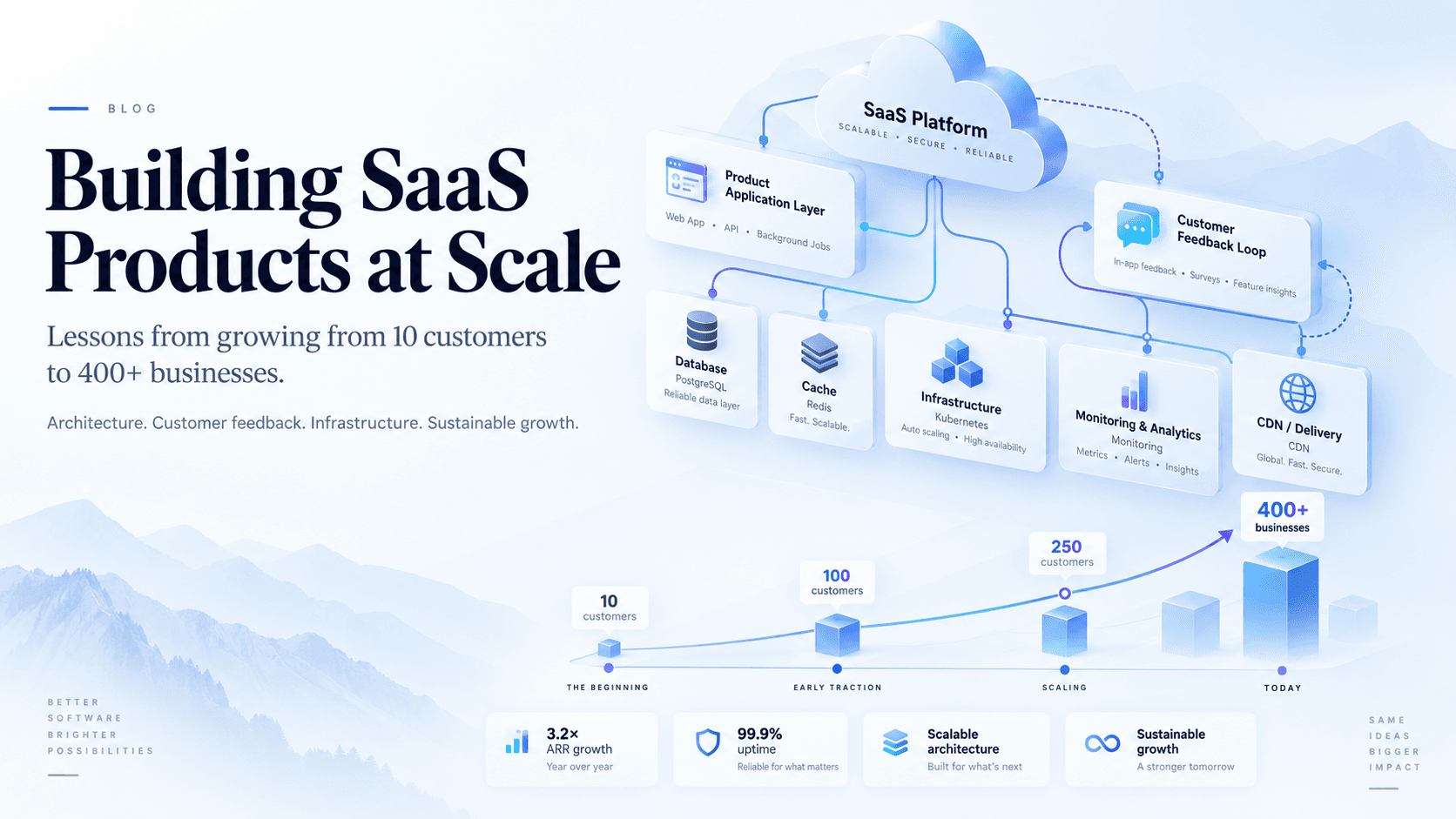
Building a SaaS product for your first 10 customers is very different from building one that needs to support hundreds of businesses every day.
At the beginning, almost everything feels manageable.
You know most of your customers personally. Support requests are easy to track. Deployments are simple. If something breaks, the team usually knows exactly where to look.
Then the product starts growing.
More customers come in. More industries start using the platform in different ways. More feature requests appear. Data volume grows. Support becomes more complex. Infrastructure that once felt “good enough” suddenly starts showing its limits.
That was one of the most important lessons I learned while helping scale a SaaS platform from a small MVP serving around 10 customers to a product supporting 400+ businesses across multiple industries.
The biggest lesson was simple:
Scaling SaaS is not just a technical problem. It is a product, architecture, customer success, and operational problem at the same time.
The Early Stage: Keep It Simple
When we started, the temptation was to think too far ahead.
Should we build microservices?
Should we use a highly distributed architecture?
Should we prepare for millions of users?
In reality, none of that was necessary at the beginning.
What we needed was a reliable product that solved a real customer problem.
That meant keeping the architecture simple enough that the team could move quickly.
A complicated system may look impressive on an architecture diagram, but if your team spends more time maintaining infrastructure than improving the product, it is probably the wrong trade-off.
My approach became:
Build for what you need today, but avoid decisions that will make tomorrow unnecessarily painful.
That is very different from trying to build for every future scenario.
Scale the Architecture When the Product Demands It
As the customer base grew, the architecture had to evolve.
The original setup worked well for a small number of businesses, but increasing usage created new problems.
Queries became slower.
Background jobs started competing for resources.
More concurrent users meant more pressure on the application.
Traffic patterns became less predictable.
At that point, infrastructure investment became necessary.
Some of the technologies we introduced included:
PostgreSQL as the primary relational database
Read replicas to reduce pressure on the main database for read-heavy workloads
Redis for caching, sessions, queues, and frequently accessed data
CDN infrastructure for serving static assets closer to users
Kubernetes where container orchestration and deployment scalability justified the additional operational complexity
Better monitoring, logging, and alerting
The important part was not the technology itself.
The important part was introducing it when there was a clear problem to solve.
I have seen teams adopt Kubernetes, microservices, event-driven architecture, and multiple databases before they even have meaningful traffic.
That often creates more engineering problems than business value.
Infrastructure should solve bottlenecks, not create new ones.
Customer Feedback Became Our Product Discovery Engine
One of the biggest changes as the platform grew was how we handled customer feedback.
With 10 customers, you can speak with almost everyone.
With 400 businesses, that becomes impossible.
At the same time, customer feedback becomes even more important because different customers start using the product in completely different ways.
We needed a more structured process.
We started using a combination of:
Weekly customer conversations
Support ticket analysis
Monthly feature voting
Usage data
Sales feedback
Quarterly roadmap reviews
This helped us separate individual requests from recurring product problems.
That distinction matters.
If one customer asks for a specific button, that does not necessarily mean you should build the button.
But if 30 customers are struggling with the same workflow, you probably have a real product problem.
Many of our strongest features came from understanding the problem behind the request instead of simply implementing what customers asked for.
Customer Success Becomes Part of the Product
At a small scale, customer support can be reactive.
Someone reports a problem.
You fix it.
You move on.
That does not work well once hundreds of businesses depend on the product.
Customer success needs to become more proactive.
We started paying more attention to questions like:
Are customers completing onboarding?
Which features are they actually using?
Where are they getting stuck?
Which accounts have stopped logging in?
Which customers are using only a small percentage of the product?
Which support issues keep appearing repeatedly?
These questions helped us see customer success as something broader than support.
Sometimes the best way to reduce support tickets was not hiring more support people.
It was improving the product.
If 20 customers keep asking the same question, the problem might be the user interface.
If onboarding constantly requires manual assistance, the onboarding process probably needs improvement.
If users are not discovering an important feature, the problem might be product education or UX.
Scaling SaaS successfully means turning recurring support problems into product improvements.
Multi-Tenant Architecture Requires Discipline
One of the more interesting challenges in B2B SaaS is that every customer wants the product to feel customized for them.
At the same time, the product needs to remain maintainable.
This creates a constant tension.
Customer A wants a different workflow.
Customer B wants another report.
Customer C wants an approval process that nobody else uses.
If you implement every request as custom logic, eventually you no longer have a SaaS product.
You have hundreds of slightly different software versions.
That becomes extremely difficult to maintain.
The better approach is usually to identify patterns.
Instead of building a feature only for one customer, ask:
Can this become configurable?
Would other customers benefit?
Does this fit the product strategy?
Can we solve the underlying problem in a reusable way?
This mindset helped us preserve a common product while still supporting different business needs.
Reliability Becomes a Product Feature
When you have 10 customers, occasional downtime is frustrating.
When hundreds of businesses rely on your platform for daily operations, downtime becomes a business issue.
Reliability is no longer just an engineering metric.
It becomes part of the product experience.
We started investing more heavily in:
Application monitoring
Database monitoring
Error tracking
Centralized logging
Automated backups
Disaster recovery
Deployment automation
Health checks
Incident response processes
Another important improvement was observability.
It is not enough to know that the server is running.
You need to know whether customers are actually able to complete important workflows.
For example:
Can users log in?
Can orders be created?
Are payments processing?
Are background jobs completing?
Are API response times increasing?
The closer monitoring gets to actual customer behavior, the more useful it becomes.
Do Not Let Feature Growth Destroy the Product
One of the biggest risks in a growing SaaS product is feature accumulation.
Every quarter, new functionality gets added.
Very little gets removed.
Over time, navigation becomes crowded, workflows become complicated, and new users struggle to understand the product.
This happens naturally because teams are usually rewarded for launching new features, not simplifying old ones.
We learned to treat product complexity as something that needs active management.
Sometimes the correct product decision is not adding another feature.
It is improving an existing workflow.
Sometimes it means merging two features.
Sometimes it means removing something.
Sometimes it means saying no.
A mature SaaS product should not become complicated simply because it has existed for a long time.
Build Around Business Outcomes, Not Feature Count
One thing I became increasingly careful about was how we measured product progress.
It is easy to say:
“We released 15 features this quarter.”
But that does not tell you whether the product became better.
Instead, we started focusing more on outcomes.
For example:
Did adoption increase?
Did customer onboarding become faster?
Did churn decrease?
Did support volume drop?
Did customers complete workflows faster?
Did revenue grow?
Did infrastructure costs remain sustainable?
These metrics tell you much more about the health of a SaaS product than the number of features released.
Growth Changes the Team Too
Scaling the product also changed how the team needed to work.
At the beginning, communication was informal.
Everyone knew what was happening.
As the organization grew, that became harder.
We needed better documentation, clearer ownership, more structured releases, stronger QA practices, and better visibility between product, engineering, sales, and support.
This is a natural part of growth.
The challenge is adding enough process to improve coordination without creating unnecessary bureaucracy.
Good processes should remove confusion.
They should not slow people down.
The Results
Over time, the combination of product improvements, infrastructure investments, and stronger customer processes produced meaningful results.
The platform grew to support:
400+ businesses
500+ active users
$2M+ in annual recurring revenue
But the most important achievement was not the number of features we shipped.
It was building a platform that could keep growing without becoming impossible to maintain.
What I Would Do Differently Today
Looking back, there are a few things I would prioritize even earlier.
I would invest sooner in observability.
I would document architecture decisions more consistently.
I would build stronger product analytics earlier instead of relying heavily on customer feedback alone.
I would introduce clearer configuration boundaries so that enterprise requests did not turn into customer-specific code.
And I would pay more attention to infrastructure cost as the product grows.
A system can scale technically while becoming financially inefficient.
Scalability needs to include economics, not just performance.
Final Thoughts
Building SaaS at scale is not about choosing the most advanced technology.
It is about making a series of good decisions at the right time.
Start simple.
Listen carefully.
Measure what customers actually do.
Invest in infrastructure when the business needs it.
Automate repetitive operations.
Protect the simplicity of the product.
And make sure every major technical investment connects to a real customer or business problem.
The lesson I keep coming back to is this:
Customers do not care how sophisticated your architecture is. They care whether your product reliably solves their problem.
Everything else should support that.